|
MOVEMENT OF TRACK CARS
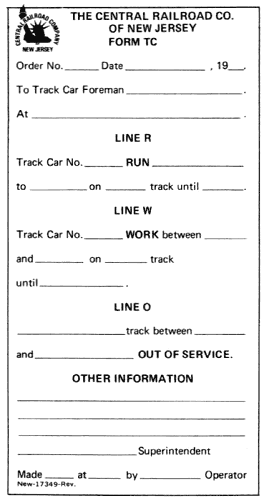
830. Track cars will not be placed on, enter, or foul main track, secondary track, or controlled siding until authorized by train dispatcher on Form TC, except as provided by Rules 830(a) and 840(a). 830(a). Except where Automatic Block System Rules are in effect, Form TC will not be required to authorize movement of track cars on single main track within yard limits. In non-signaled territory, track cars using single main track within yard limits must clear first and second class trains as per Rules 86 and S-87 or protect as per Rule 99, but not protecting against other trains, engines or track cars. Track cars using single main track within yard limits must not exceed yard speed. 831. Form TC, Line R, will be used to authorize movements in one direction.
832. Form TC, Line W, will be used to authorize movement in either direction. (Work between the points shown.)
833. Form TC, Line O, must be used to remove track from service. (Out of Service between the points shown.) 834. The line for "Other Information" on Form TC will include any information
835. Form TC will be numbered, addressed, transmitted, repeated, made complete and delivered in the same manner as specified for train orders. The train dispatcher must record all Form TC orders issued in the book provided for that purpose. 836. Track car foreman will read Form TC to occupants of track car before it is acted upon. 837. Track cars must clear main or secondary track before time limit specified on Form TC unless another Form
TC is issued to authorize further use of track. Track cars will not be considered clear at 838. Track car foreman must immediately report to train dispatcher when track car is clear of main or secondary track. After track car has been reported clear to train dispatcher, the main or secondary track must not be occupied again by track cars until authorized by another Form TC. 839. Track cars must not be admitted to a track between two opposing controlled home signals unless track is clear of opposing trains, engines or track cars. and levers of such signals are blocked in "stop" position with approved blocking devices. 840(a). Form TC will not be used for movements within interlocking limits- Track car movements within interlocking limits will be made upon permission of signalman in accordance with Rule 637. 840b). Track cars must not foul or operate within interlocking limits without permission of signalman and interlocking signal displaying a "proceed" indication. Signalman must be notified when movement has been completed unless there is a prior understanding. When "proceed" interlocking signal cannot be displayed, track car foreman will obtain verbal permission from signalman to proceed looking out for switches not properly lined and notify signalman when movement has been completed. 840(c). Movement of track cars through unattended interlockings will be governed by signal indication, or in the absence of signals, by Time Table instructions. 841. Track cars approaching workmen on or near the track must sound a warning and move prepared to stop. 842(a). Flashers and/or gates must be actuated before track cars, other than Hy-Rail Cars, may proceed over crossing. At all other crossings, movement must be protected by flagman as per Rule T-4, 842(b). Hy-Rail Cars will approach all grade crossings prepared to stop end will pass over such crossings when the way is clear. 843. Track cars will display by night: a white light to the front and a red light to the rear. Hy-Rail Cars
must display headlights continuously on high beam when on tracks. 844. When track car or equipment may foul or create a condition affecting the safe movement of trains moving on adjacent tracks, such tracks will not be fouled without permission of the train dispatcher. This will not relieve maintenance of way crews from protecting all tracks affected as per Rule 99. 845. Push trucks must be protected as per Rule 99. 846. When train is approaching on adjacent track, track car will stop and occupants will leave car on side away
from approaching train. Occupants will stand clear of track car, away from direction of movement of train. When
practicable, occupants will observe both sides of train for defects and communicate with train crew in accordance
with Rule S. |